



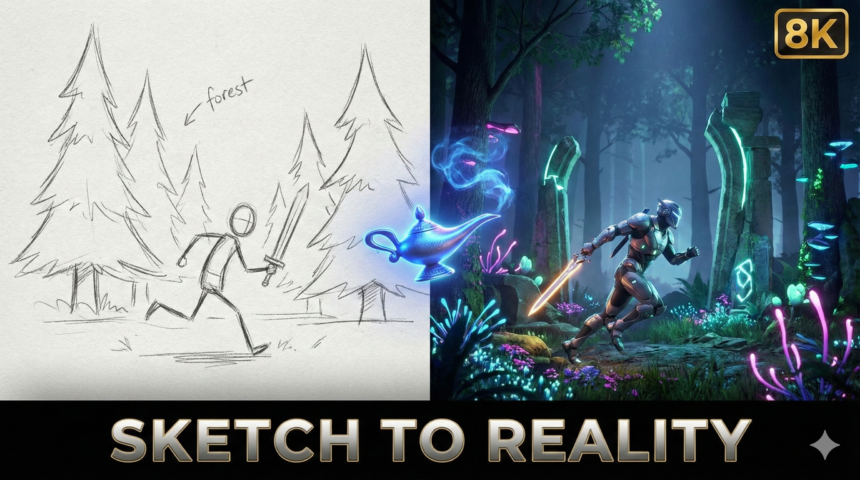
Imagine typing “A cyberpunk city made of neon noodles” into a search bar, and instead of getting a static image, you get a fully playable video game level that you can run, jump, and explore in 3D. Sounds like sci-fi? Well, Sundar Pichai just turned it into reality.
- What Exactly is Google Genie?
- How Does It Work? (The Magic Under the Hood)
- The “Game Changer” Argument: Why Develpers Are Sweating
- Genie vs. The World: A Quick Comparison
- The “Reality Check”: It’s Not Perfect Yet
- Why Is This “Genie” Better Than “Sora”?
- Industry Reaction: Panic or Opportunity?
- Conclusion: A New Era of “Play”
- Frequently Asked Questions (FAQ)
- 🔗 Social Proof
Google has officially dropped a nuclear bomb on the creative industry with Project Genie (Genie 3). Sundar Pichai, usually calm and composed, couldn’t hide his excitement, calling the tool “out of this world” in a recent announcement.
But is this just another AI hype train like the Rabbit R1, or is it actually the “Unity Killer” that game developers should fear? Let’s decode the magic, the logic, and the reality behind Google’s Genie.
What Exactly is Google Genie?
Genie (Generative Interactive Environments) is not just a video generator. Do not confuse it with OpenAI’s Sora. Sora makes videos you can watch. Genie makes worlds you can play.+2
Powered by the new Genie 3 model, combined with Nano Banana Pro (Google’s latest image synthesis tool) and Gemini, this AI takes a simple text prompt or a rough sketch and converts it into a functional, interactive 3D environment.
The Core Concept:
It doesn’t code the game. It dreams the game frame-by-frame. It predicts what the next frame should look like based on your controller input (jumping, moving left/right). It’s like a hallucination that follows the laws of physics.+1
Sundar Pichai’s Take: “I’ve been playing around with it a bit and it’s out of this world.” — Via X (Twitter)
How Does It Work? (The Magic Under the Hood)
For the non-techies, here is the simple breakdown. You don’t need C# or Python. You just need an imagination.

- The Prompt: You type, “A dark forest where trees are made of glass.”
- The Sketch: The Nano Banana Pro engine generates a high-quality reference image.
- The World Building: Genie 3 takes that image and extrapolates it into a 3D space.
- The Interaction: You press ‘Right’ on your keyboard. Genie predicts: “If the character moves right, the background should shift left, and the character’s legs should move.” It renders this in real-time.
It is effectively a “neural game engine.” It learns physics not by being programmed with gravity equations, but by watching millions of hours of platformer games and robbery videos.
The “Game Changer” Argument: Why Develpers Are Sweating
The release of Genie sent shockwaves through the stock market, with companies like Roblox and Unity seeing dips. Why? Because Genie democratizes world-building.
1. The End of “Asset Flipping”
Traditionally, making a game level takes weeks. You need 3D modelers, texture artists, and lighting experts. Genie does this in seconds. For indie developers, this is a miracle. For asset store sellers, it’s a nightmare.
2. Infinite Playability
Since Genie generates the world on the fly, the game never has to end. It can technically generate an infinite map as long as you keep walking. It is the ultimate “Procedural Generation.”
3. Training Robots (The Real Secret)
Google isn’t just making this for gamers. They are using Genie to train robots. If you want to teach a robot how to not bump into a table, you don’t need to build a physical room. You just ask Genie to generate a million variations of a messy room and let the AI robot practice inside the simulation.
Genie vs. The World: A Quick Comparison
Here is how Google Genie stacks up against the current titans of industry.
| Feature | Google Genie 3 | OpenAI Sora | Unreal Engine 5 |
| Output | Interactive Playable World | Passive Video | High-Fidelity Game |
| Skill Required | Zero (Just Typing) | Zero (Just Typing) | High (Coding/3D Art) |
| Physics | AI-Predicted (Dreamt) | Visual Only | Hard-Coded (Real) |
| Best For | Prototyping / Fun | Filmmaking | AAA Game Dev |
| Cost | Cloud Compute (High) | High | High (Time-wise) |
The “Reality Check”: It’s Not Perfect Yet
Before you cancel your Netflix subscription to play AI games, let’s look at the limitations. Google calls this a “Research Preview” for a reason.
- The 60-Second Limit: Currently, the memory of the model is short. After about 60 seconds of exploration, the world might start to “hallucinate” or lose coherence (e.g., a door suddenly turns into a wall).
- The FPS Drop: It runs at around 24 frames per second (FPS). Competitive gamers accustomed to 120 FPS will find this sluggish.
- No “Game Logic”: It can make a world, but it can’t yet make complex rules like “If I collect 10 coins, I win.” It’s a playground, not a game.
Why Is This “Genie” Better Than “Sora”?
OpenAI’s Sora stunned us with realistic video. But Sora is a movie director; Genie is a game master.
The Interaction Factor:

If you see a door in a Sora video, you can only watch it. If you see a door in a Genie world, you can open it. That difference is massive. It marks the shift from Generative Media to Generative Simulation.
Industry Reaction: Panic or Opportunity?
The gaming industry is split.
- Indie Devs: “This is amazing! I can finally prototype my dream game.”
- AAA Studios: “It’s a toy. It can’t replace our optimized engines.”
- Investors: Selling stocks just in case.
The truth lies in the middle. Genie won’t replace Grand Theft Auto 6 anytime soon. But it might replace the tools used to build GTA 7.
Conclusion: A New Era of “Play”
Sundar Pichai wasn’t exaggerating. Genie AI is a glimpse into a future where the barrier between “imagining” a world and “visiting” it is dissolved.
Is it a game changer? Yes.
Not because it’s perfect today, but because it proves that video games can be dreamt by computers rather than coded by humans.
For now, it’s a fun toy for US Ultra subscribers. But give it two years, and we might all be playing games that don’t even exist until we press “Start.”
Frequently Asked Questions (FAQ)
Q1: Can I play games made by Genie right now?
Yes, but only if you are a Google AI Ultra subscriber in the US. It is currently in a “Labs” experimental phase.

Q2: Does Genie replace Unity or Unreal Engine?
Not yet. Genie is good for prototyping and simple loops. It lacks the complex logic, scoring systems, and multiplayer infrastructure that engines like Unity provide.
Q3: Is Genie free to use?
Currently, it is part of Google’s premium AI subscription tier. Considering the heavy computing power required to generate worlds in real-time, it is unlikely to be fully free soon.
Q4: Can Genie make games from my own drawings?
Yes! You can upload a sketch of a character or a level, and Genie will bring it to life, allowing you to control your doodle in a 3D space.
🔗 Social Proof
Check out the official announcement and Sundar Pichai’s reaction on X (formerly Twitter):