



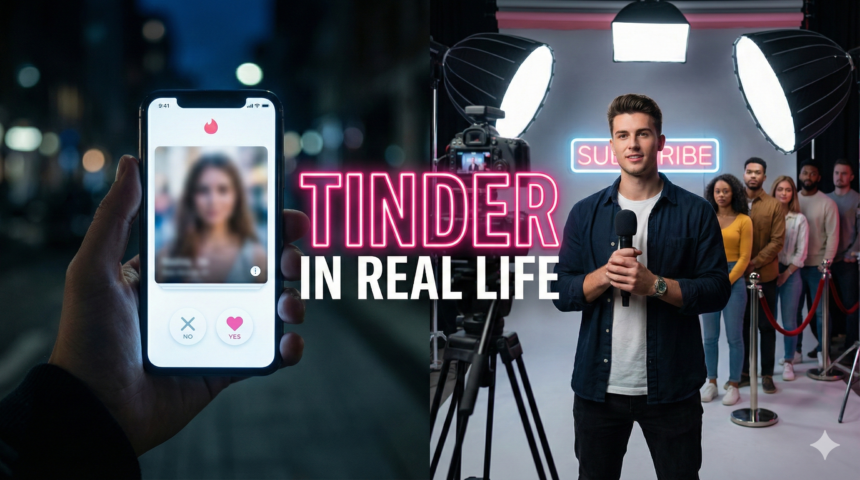
Let me paint a picture for you. You are sitting on your couch on a Friday night, staring at your phone. You swipe left. You swipe right. You match with someone, type a half-hearted “Hey,” and never get a reply. Modern dating apps have turned romance into a tedious chore. People are suffering from swipe fatigue, and the algorithm feels less like a matchmaker and more like a cruel digital overlord.
- What Exactly is the “Tinder in Real Life” Format?
- The Core Rules of the Game
- The Pioneers: From Sidemen to Jubilee
- The Indian YouTube Explosion: Allen Choudhary and the Controversy
- Comparison: Digital Apps vs. Real Life YouTube Shows
- The Psychology: Why We Can’t Stop Watching the Cringe
- Is It Scripted or 100% Real?
- How the Algorithm Fuels the Fire
- Conclusion
But what if you took that exact swiping mechanism, removed the screens, and forced people to do it face-to-face in a warehouse full of cameras?
Welcome to the Tinder in Real Life show—the YouTube phenomenon that has completely hijacked the internet. Instead of hiding behind filtered photos and AI-generated bios, participants have to walk up to a stranger, deliver a pickup line while maintaining brutal eye contact, and face immediate, public rejection.
It is awkward. It is hilarious. And it is absolutely impossible to look away from. As an SEO and digital culture expert, I have watched this format evolve from a niche experiment into a multi-million-view cash cow for content creators. Let’s break down how this format works, who the biggest players are, and why we are all addicted to the cringe.
What Exactly is the “Tinder in Real Life” Format?
At its core, the Tinder in Real Life (IRL) show takes the mechanics of a dating app and turns it into a live-action game show.
Usually, one central participant (the “swiper”) stands in the middle of a room. A line of potential suitors walks up to them one by one. The suitor has exactly a few seconds to introduce themselves, do a trick, or drop a cheesy pickup line.
If the central participant likes them, they say “Swipe Right,” and the suitor goes into a winner’s bracket. If they don’t like them, they say “Swipe Left,” and the suitor has to take the “walk of shame” to the exit. There are no second chances, no ghosting, and absolutely no time to Google a witty comeback.
The Core Rules of the Game
- The Setup: One person judges; 20 to 100 people compete.
- The Introduction: Suitors get 10 seconds to make an impression.
- The Verdict: A brutal, instant “Yes” or “No” to their face.
- The Finale: The remaining “matches” go on a rapid-fire speed date to crown a final winner.
The Pioneers: From Sidemen to Jubilee
This format didn’t just appear out of nowhere. It evolved through massive YouTube channels testing the boundaries of social interaction.
The British YouTube super-group Sidemen essentially perfected the genre. Their “Sidemen Tinder in Real Life” series routinely pulls in over 70 million views per video. They turned it into a massive spectacle, bringing in internet models, comedians, and influencers to roast each other. The appeal of the Sidemen version lies in the camaraderie and the completely unhinged pickup lines that you would never dare say in an actual bar.
Following suit, channels like Jubilee took a slightly different approach. Jubilee’s IRL dating shows often focus on the psychological and social dynamics, making them slightly more grounded but equally intense. Watching a Jubilee video feels like a social experiment, where the rejection cuts a little deeper because it feels so raw.

The Indian YouTube Explosion: Allen Choudhary and the Controversy
While the West popularized the format, Indian creators have turned it into a completely different beast. Enter creators like Allen Choudhary and Fukra Insaan.
Allen Choudhary recently shook the Indian YouTube space with his extreme variations, such as the “100 Vs 1 Tinder In Real Life” series. Imagine 100 guys lining up to impress one girl. The logistics alone are insane, but the content is pure, unfiltered chaos.
However, with viral fame comes intense scrutiny. Choudhary’s shows have faced massive backlash from the online roasting community. Creators like SunRayBee and Adit Minocha have actively called out the show for being highly staged and occasionally crossing ethical lines (such as allegedly featuring participants who look far too young for a dating show).
Despite the roasts—or perhaps because of them—the views keep climbing. The controversies act as free marketing, pushing the YouTube algorithm to recommend these videos to millions of curious viewers. You can see the chaotic behind-the-scenes of his life on his official Instagram here: Allen Choudhary on Instagram.
Comparison: Digital Apps vs. Real Life YouTube Shows
To truly understand why this format works, we need to compare the traditional app experience with the YouTube spectacle. Here is a detailed breakdown.
| Feature / Metric | Traditional Dating Apps (Tinder, Bumble) | Tinder In Real Life (YouTube Show) |
| First Impression | Carefully curated, filtered photos. | Real-time body language and voice tone. |
| Time to Evaluate | Milliseconds to unlimited time. | 10 to 15 seconds maximum. |
| Rejection Method | Silent swiping (Ghosting). | Verbal rejection directly to the face. |
| Anxiety Level | Low (Hiding behind a screen). | Extreme (Public performance pressure). |
| Primary Goal | Finding a date or relationship. | Maximizing entertainment and views. |
| Use of AI/Tech | High (Algorithms, AI Photo Selectors). | None (Pure human interaction). |
| The “Cringe” Factor | Private text messages. | Public humiliation captured in 4K resolution. |
| Participant Safety | Stranger danger, catfishing risks. | Controlled studio environment with security. |
| Financial Outcome | Users pay for premium features. | Creators earn millions via YouTube AdSense. |
| Pacing | Slow, asynchronous communication. | Fast-paced, high-energy editing. |
| Authenticity | Often plagued by fake personas. | Staged elements, but raw emotional reactions. |
| Audience | Just the two people matching. | Millions of viewers analyzing every move. |
| Pickup Lines | Copied and pasted from Google. | Delivered verbally, often stumbling over words. |
| Success Rate | Low match-to-date conversion. | Pre-determined finale winner. |
| Aftermath | Awkward first dates. | Viral memes and internet fame. |
The Psychology: Why We Can’t Stop Watching the Cringe
As humans, we are naturally voyeuristic. We love watching other people navigate awkward social situations, especially when we are safely hidden behind our laptop screens.
The Tinder in Real Life show triggers our empathy and our schadenfreude (finding joy in someone else’s misery). When a guy walks up and completely forgets his pickup line, your stomach drops for him. When a girl delivers a savage, witty rejection, you cheer for her.
Furthermore, these videos serve as a masterclass in modern social dynamics. They highlight exactly how much looks, confidence, and humor matter in those crucial first 10 seconds of meeting someone. In an era where dating has become hyper-digital, watching people fail and succeed in the real world feels weirdly refreshing.
Is It Scripted or 100% Real?
This is the most common question I get asked about these shows. The short answer? It is “Produced Reality.”
You cannot gather 100 people in a room, set up expensive cameras, and just hope something funny happens. Creators heavily vet the participants. They look for massive personalities, weird talents, and people who are not afraid to look foolish on camera.

While the actual rejections and the stutters are usually genuine, many of the wilder pickup lines are pre-planned. The creators know that the audience wants extreme reactions, so they encourage participants to be as loud and controversial as possible. It is less like a documentary and more like professional wrestling—you know it is heightened for entertainment, but you enjoy the ride anyway.
How the Algorithm Fuels the Fire
From an SEO and digital marketing perspective, the “IRL Dating” format is a cheat code for the YouTube algorithm.
These videos have incredibly high retention rates. Why? Because the format is inherently fast-paced. A new person steps up every 20 seconds. If a viewer finds one participant boring, they know they only have to wait a few seconds for the next one. This rapid-fire pacing keeps the viewer’s attention locked, which tells YouTube that the video is highly engaging.
Consequently, YouTube pushes the video to the trending page, resulting in massive subscriber growth for the creator. It is a perfect loop of engagement, controversy, and algorithmic reward.
Conclusion
The Tinder in Real Life show format proves one universal truth: human connection is messy, awkward, and highly entertaining.
While dating apps continue to add AI features to make matching “easier,” YouTube creators are doing the exact opposite. They are making it harder, louder, and infinitely more public. Whether you watch it to learn how to flirt, or just to laugh at the terrible pickup lines, this format isn’t going anywhere anytime soon.
The next time you open a dating app, just be glad you don’t have to swipe right on someone while a camera crew films your every move.
Frequently Asked Questions (FAQ)
1. Who started the Tinder in Real Life YouTube trend?
While many channels experimented with IRL dating, the UK-based YouTube group “Sidemen” is widely credited with popularizing the specific “Tinder in Real Life” format, turning it into a massive viral franchise.
2. Are the people in these videos actors?

Most participants are aspiring influencers, local volunteers, or fans of the creator. While they are not traditional Hollywood actors, they know they are on camera and often play up their personalities for maximum entertainment value.
3. Is Allen Choudhary’s 100 vs 1 dating show real?
It is a mix of reality and produced entertainment. The participants are real people, but the scenarios, the pacing, and some of the interactions are highly curated and edited to create a viral, often controversial, narrative.
4. Why do YouTubers make these dating videos?
These videos generate incredibly high viewer retention and engagement. The fast-paced nature of the “swipe” mechanic keeps viewers watching until the end, which leads to massive AdSense revenue and channel growth.
5. Can I use the Tinder logo in my own YouTube video?
Legally, the Tinder app and its logos are copyrighted by Match Group. However, most YouTubers use the concept under “Fair Use” for parody or entertainment. It is always safer to create your own generic swiping graphics to avoid copyright strikes.