



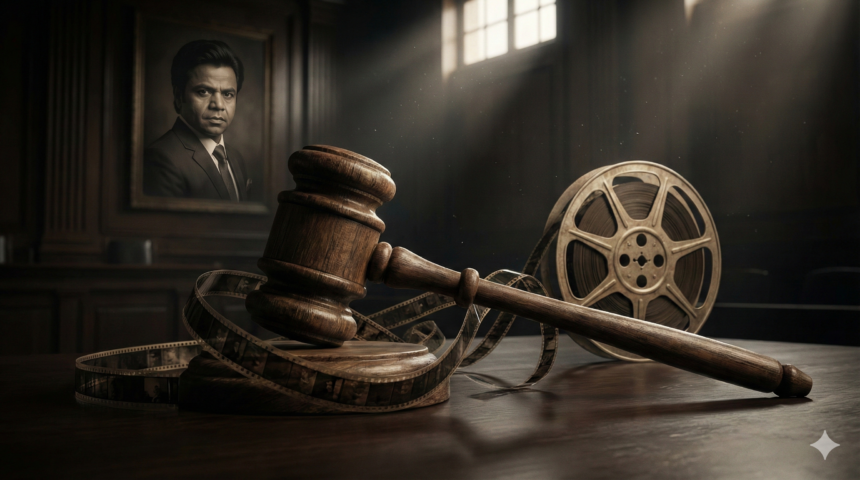
We all know the face. The manic energy, the confused stutter, the physical comedy that made Chup Chup Ke and Bhool Bhulaiyaa cult classics. Rajpal Yadav has spent two decades making a billion people laugh. But in 2013, the laughter stopped abruptly. The slapping scenes were replaced by handcuffs, and the movie sets were swapped for Tihar Jail.
I remember when the news first broke. It didn’t feel real. How could the guy who played “Chhota Don” actually end up in a real-life legal mess involving crores of rupees? It sounded like a bad script. But it wasn’t.
The Rajpal Yadav cheque bounce case is a textbook example of how a dream project can turn into a financial and legal nightmare. It wasn’t just about unpaid money; it was about bad advice, misleading affidavits, and the unforgiving nature of the Indian legal system when you try to play smart with it.
If you think this is just another “celebrity gets away with it” story, think again. This is the story of how the Delhi High Court made an example out of one of India’s most loved comedians.
The Origin Story: The Director’s Chair Trap
In my experience covering the entertainment industry, I’ve noticed a pattern: every great character actor eventually wants to direct. It’s the “Chaplin Syndrome.” They want creative control.
For Rajpal, this dream was a film called Ata Pata Laapata.
In 2010, Rajpal and his wife, Radha Yadav, needed capital to fund this directorial debut. They approached a Delhi-based businessman, M.G. Agarwal (owner of Murli Projects). The deal was struck for a loan of approximately ₹5 crore.
At the time, it seemed like a standard industry transaction. You borrow, you make the movie, the movie hits big, and you pay back the principal with interest. But here is the thing about the box office—it’s a gamble. Ata Pata Laapata released in 2012 and, to put it politely, it didn’t exactly set the cash registers ringing. It was a commercial disaster.
The money was gone. And M.G. Agarwal wanted his investment back.
The Core Problem: When The Cheques Bounced
This is where things got messy. Rajpal’s company, Shree Naurang Godavari Entertainment, had issued post-dated cheques to repay the loan. When Agarwal tried to cash them, they bounced due to “insufficient funds.”
Now, for those who don’t know, a bounced cheque in India isn’t just an “oops” moment. It falls under Section 138 of the Negotiable Instruments Act. It is a criminal offense.
Agarwal didn’t wait around. He filed a case against Rajpal, his wife, and their company. But the rajpal yadav cheque bounce case didn’t become a headline just because of the debt. It became a headline because of what Rajpal did next.

Most people get this wrong: they think Rajpal went to jail solely because he couldn’t pay the money. That’s not entirely true. He went to jail because he tried to outsmart the court.
The “False Affidavit” Blunder
In legal battles, credibility is your currency. If you lose that, you lose everything.
When the recovery suit was filed in the Delhi High Court, Rajpal claimed he didn’t have the money. But the court found discrepancies. He allegedly tried to conceal his financial assets. In December 2013, he filed an affidavit that the court found to be “false and misleading.”
Justice S. Ravindra Bhat (who was presiding at the time) didn’t take kindly to this. He famously noted that Rajpal was “economical with the truth.”
This was the turning point. The case shifted from a simple recovery suit to Contempt of Court. The judge felt the actor was trivializing the legal process.
The Sentence: 10 Days vs. 3 Months
I recall the shockwaves in the industry on December 3, 2013. The Delhi High Court sentenced Rajpal Yadav to 10 days in judicial custody for concealing facts.
Imagine the scene: The police took him directly from the High Court to the lockup. His wife, who was holding their infant daughter, was also involved in the case but was spared custody due to the child.
But that was just the appetizer. The legal battle dragged on for five more years.
In 2018, the hammer dropped again. The court concluded that Rajpal had failed to repay the loan (which had ballooned to over ₹10 crore with interest) despite repeated undertakings. The sentence? Three months in civil prison.
He served this sentence in Tihar Jail (Jail No. 7). Later, in interviews, he described it as a “spiritual experience” where he conducted workshops for inmates, but make no mistake—it was a career-threatening blow.
Comparison: A Standard Case vs. The Yadav Case
To help you understand why this case was so unique, let’s compare a typical debt dispute with what happened here.
| Feature | Standard Cheque Bounce Case | Rajpal Yadav’s Case |
| Primary Issue | Failure to pay debt (Civil/Criminal) | Failure to pay + Misleading the Court |
| Court’s Reaction | Usually grants time for settlement | Aggressive due to false affidavits |
| Jail Time | Rare for first offense if intent to pay is shown | Immediate custody for Contempt of Court |
| Asset Seizure | Bank accounts frozen | Personal assets attached involved investigation |
| Public Perception | “Business deal gone wrong” | “Actor trying to hoodwink the system” |
3 Insider Lessons From This Saga
Having watched this case unfold over a decade, here are three things that usually get buried under the sensational headlines.

The “Settlement” Trap is Deadly
In my experience, the worst thing you can do is agree to a settlement you cannot honor. Rajpal repeatedly told the court, “I will pay by X date,” and then failed to do so. Every missed deadline chipped away at the judge’s patience. If you are broke, admit it. Don’t promise money you don’t have just to buy a week’s time.
Producers Are Vulnerable
We see actors as rich superstars, but independent producers (which Rajpal became) are incredibly vulnerable. He mortgaged his reputation for a film that had no market. It’s a cautionary tale for any actor trying to pivot to production without a solid distribution network.
Section 138 is a Double-Edged Sword
While the Negotiable Instruments Act is meant to protect lenders, it can trap borrowers in a loop of litigation. Rajpal faced seven different cases. The legal fees alone likely cost him a fortune, compounding his debt.
Is He Out of the Woods?
Yes and no.
Rajpal served his time. He came out in late February 2019. Since then, he has focused entirely on what he does best: acting.
He made a massive comeback with Bhool Bhulaiyaa 2 and Dream Girl 2. He publicly stated that he has cleared the dues and wants to leave the past behind. However, the stain of a jail term is hard to wash off in an industry that relies on “bankability.”
The good news? The audience doesn’t care about court orders; they care about comedy. And Rajpal still delivers that in spades.
Frequently Asked Questions (FAQ)
1. Why exactly was Rajpal Yadav sent to Tihar Jail?
While the root cause was the ₹5 crore loan he couldn’t repay, the immediate reason for his 2013 and 2018 jail terms was Contempt of Court. He filed a false affidavit regarding his assets, which angered the Delhi High Court.
2. How much money did Rajpal Yadav owe in total?
The original loan in 2010 was ₹5 crore. However, due to high interest rates and years of non-payment, the amount swelled. By the time of the 2018 judgment, reports suggested the liability was around ₹10 crore.
3. Did the movie Ata Pata Laapata release?

Yes, it was released in November 2012. It was a political satire produced and directed by Rajpal Yadav. Unfortunately, it performed poorly at the box office, which triggered the financial crisis.
4. Can you really go to jail for a bounced cheque in India?
Absolutely. Under Section 138 of the Negotiable Instruments Act, a bounced cheque is a criminal offense punishable by up to two years in jail, a fine up to twice the cheque amount, or both.
5. Is Rajpal Yadav still working in movies?
Yes, he is very active. After his release in 2019, he appeared in hits like Bhool Bhulaiyaa 2, Coolie No. 1, and Ardh. He has managed to rebuild his career successfully.
Final Thoughts
The Rajpal Yadav cheque bounce case serves as a stark reminder that in the eyes of the law, stardom is not a shield.
It’s easy to judge him for the financial mismanagement, but one has to admire his resilience. He took the hit, served his time, and came back to work without playing the victim card.
For any aspiring filmmakers or entrepreneurs reading this: never sign a personal guarantee unless you are 100% sure of your cash flow. And more importantly, never, ever lie to a High Court judge.