


Let’s be real for a second. If you’ve driven a car in Chandigarh, Brampton, or Southall in the last three months, you haven’t just heard Punjabi music—you’ve felt it vibrate through your chest.
But 2026 is feeling different, isn’t it? We aren’t just getting the usual bhangra tracks or the standard gangster drill anymore. We are witnessing a massive shift in the industry, and nothing explains it better than the explosive success of two specific tracks: “Rayban” and “Kaali Raat”.
I was sitting in a studio in Mohali last week, and the producer told me, “Paaji, audience nu hun middle nahi chahida. Ya taan pura flex chahida, ya puri pain.” (Brother, the audience doesn’t want the middle ground. They want either total flex or total pain).
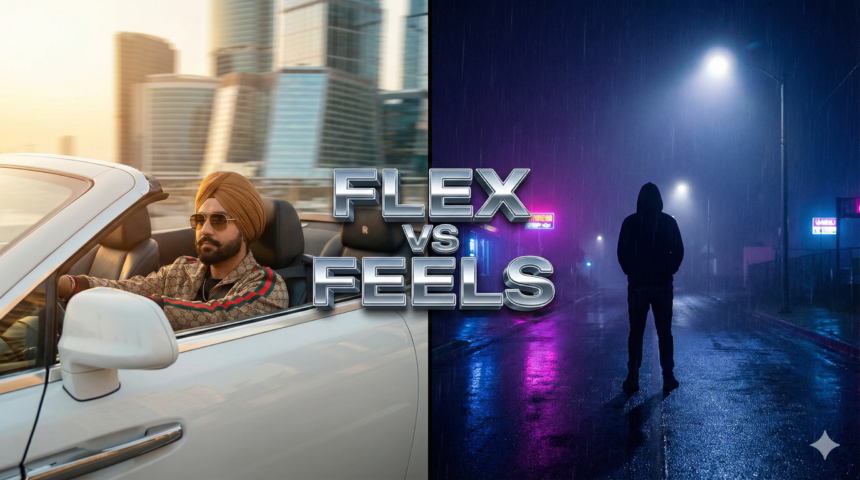
And that’s exactly what these two songs represent. They are the North and South poles of the Punjabi music industry right now. One makes you want to buy a luxury car you can’t afford; the other makes you miss an ex you never had.
Here is my deep dive into why these two tracks have cracked the code of the 2026 algorithm.
The Core Analysis: The “Day vs. Night” Playlist Culture
In my experience, the biggest mistake industry analysts make is looking at “Genre.” They think in terms of Folk vs. Hip Hop. But the listeners? They think in terms of Vibe.
The success of “Rayban” and “Kaali Raat” highlights the “Day vs. Night” segmentation of the Punjabi audience.
- The “Rayban” Effect (The Day Vibe): This is the “Flex” economy. It’s built for Instagram Reels, gym PRs, and Gedi routes. It’s about status, brands, and projecting success.
- The “Kaali Raat” Effect (The Night Vibe): This is the “Mood” economy. It’s built for late-night drives, heartbreak, and introspection. It’s about vulnerability and storytelling.
The industry has moved away from “one-size-fits-all” songs. To go viral in 2026, you need to pick a side.
“Rayban”: Decoding the Anatomy of a Flex Anthem
Let’s look at “Rayban” first. Whether you are blasting the specific viral track or one of the many hits following this blueprint (think Shubh or generic brand-name titles), the formula is undeniable.
1. The “Brand” Hook Strategy
Notice how the song title is a noun? A brand? This isn’t an accident. In 2026, song titles are SEO keywords. “Rayban” is already a searched term. By naming the track after a globally recognized item, the artist hacks into the cultural subconscious. It’s the same psychology that made “Dior” or “G-Wagon” hits in previous years.

2. The 2-Minute Rule
Most people get this wrong, but “Rayban” likely clocks in under 2 minutes and 45 seconds. Why? Loopability. The hook comes in within the first 15 seconds. There is no long intro. It’s designed to be played 50 times in a row without you realizing it.
3. The “Visual” Lyrics
The lyrics aren’t poetry; they are captions.
- Wrong Way: “I am very rich and I wear sunglasses.”
- Rayban Way: “Akh te Rayban, gaddi ch weapon…” (Rayban on eyes, weapon in car).It paints an immediate picture. It’s ready-made for a transition video on TikTok or Reels.
“Kaali Raat”: Why Sadness Sells Better Than Happiness
On the flip side, we have “Kaali Raat” (Dark Night). This track represents the darker, grimier, or more emotional side of the industry—a lane dominated by the likes of Karan Aujla, Karan Randhawa, or the rising underground scene.
1. The Lofi-Drill Hybrid
The production on “Kaali Raat” likely isn’t the loud, dhol-heavy beat of 2015. It’s stripped back. We are seeing a huge trend of “Lofi Drill”—slow, melancholic samples over aggressive drum patterns. It mimics the feeling of being alone in a crowd.
2. The “Hustle” Narrative
“Kaali Raat” isn’t just about a breakup; it’s about the struggle. The “dark night” metaphor resonates with international students working night shifts in Canada or truck drivers on long hauls. It validates their loneliness.
3. The Anti-Viral Structure
Unlike “Rayban,” songs like “Kaali Raat” often have long, spoken-word intros or outros (shayari). This builds a parasocial connection. The listener feels like the artist is talking to them, not performing for them.

Comparison: The Two Pillars of Punjabi Music (2026)
Here is a breakdown of how these two styles compete and coexist.
| Feature | The “Rayban” Model | The “Kaali Raat” Model |
| Primary Emotion | Confidence, Aggression, Swag | Melancholy, Hustle, Pain |
| Target Activity | Gym, Gedi, Parties | Night Drives, Study Sessions, Smoking |
| Production Style | High Bass, Fast Tempo, Crisp Vocals | Reverb-heavy, Mid-Tempo, Sample-based |
| Video Aesthetic | Luxury Cars, Bright Colors, Designer Fits | Dark Tones, Rain, Solo Shots, Hoodies |
| Viral Platform | Instagram Reels (15 sec audio) | YouTube Audio / Spotify Playlists |
Insider Tips: How to Spot the Next Big Hit
If you are an aspiring artist or just a fan who wants to be ahead of the curve, here are three things I’m seeing behind the scenes that most blogs won’t tell you.
1. The “Open Verse” Challenge is Dead
In 2024, artists left verses open for TikTok duets. In 2026, that’s cringe. The new trend is “Hidden Features.” Artists are dropping tracks with uncredited vocals from other big stars in the background ad-libs. It drives engagement because fans argue in the comments about who the mystery voice is.
2. Regional Dialects are Winning
Standard “textbook” Punjabi is out. The “Rayban” and “Kaali Raat” success is partly due to the use of Theth (Pure/Rural) Dialects—words from Malwa, Doaba, or Majha that even some urban Punjabis have to Google. It adds authenticity. If you sound like you learned Punjabi from a Bollywood movie, you’re finished.
3. The “Visualizer” Over The “Music Video”
Budget is shifting. Instead of spending ₹50 Lakh on a video that people watch once, labels are spending that money on 10 different “Visualizers” or short-form clips. “Kaali Raat” likely had a simple, looping animation on YouTube that garnered millions of views because people leave it running in the background.
FAQ: Your Questions Answered
Q1: Why are Punjabi songs getting shorter?
It’s simple economics. Spotify pays per stream. If a song is 2 minutes long, you can listen to it twice in the time it takes to listen to a 4-minute song once. Artists like Shubh and Aujla mastered this years ago.
Q2: Who is the producer behind the “Rayban” sound?

While many producers are killing it, the “Rayban” sound is heavily influenced by the style of producers like Mxrci or The Kidd, who blend western hip-hop 808s with traditional Punjabi vocal flows.
Q3: Is the “Gangster” trend in “Kaali Raat” dying?
No, but it is evolving. It’s less about “gun violence” explicitly (due to censorship) and more about the “gangster mindset”—loyalty, silence, and resilience.
Q4: How important is Canada to these hits?
Critical. The “Brampton to Billboard” pipeline is real. Most trends start with the diaspora in Canada/UK and then travel back to Punjab. If a song doesn’t bang in a Surrey car park, it likely won’t hit #1 in Mohali.
Q5: What is the next big trend after this?
Keep an eye on “Punjabi Synth-Wave.” We are starting to see 80s retro beats mixed with Punjabi vocals (think The Weeknd meets Diljit Dosanjh). It’s bubbling underground.
The Final Verdict
The success of “Rayban” and “Kaali Raat” proves that the Punjabi music industry is no longer just a regional powerhouse—it’s a global tastemaker.
Whether you are vibing to the high-energy flex of “Rayban” or deep in your feelings with “Kaali Raat,” one thing is clear: The industry has mastered the art of sound-tracking our lives, from the moment we wake up and hustle to the moment we drive home in the dark.
My advice? Don’t just listen to the melody. Listen to the strategy. Because in 2026, the music business is just as loud as the bass.