


Let’s be honest. If you are an Indian Gen Z, your Instagram feed is probably 40% memes, 20% friends getting married, and 40% reels of glass-skinned Korean models applying seven layers of toner.
- The “Glass Skin” Dream vs. Indian Reality
- The “Hallyu” Effect: BTS Made Me Buy It
- Ingredients That Actually Work (The Science)
- Snapshot: K-Beauty Ingredients vs. Indian Skin Concerns
- The “Haul” Culture: Why We Buy in Bulk
- 2026 Trends: From 10-Step to “Skinimalism”
- Top Brands Ruling the Indian Market
- Conclusion: A Lifestyle, Not Just a Lotion
- Frequently Asked Questions (FAQ)
- 🔗 Social Proof
Gone are the days when “skincare” meant splashing water on your face and applying a layer of Vicco Turmeric. Today, the bathroom cabinet of an average 20-year-old in Mumbai or Delhi looks like a chemistry lab from Seoul. We are talking about Snail Mucin, Centella Asiatica, and sunscreens that cost more than a college semester’s stationary budget.
But why is India—a country with its own rich history of Ayurveda—suddenly obsessed with K-Beauty? Is it just the BTS effect, or is there actual science behind the slime? Let’s decode the “Hallyu” hydration hype.
The “Glass Skin” Dream vs. Indian Reality
The obsession started with a single phrase: “Glass Skin.”
It is the idea of skin so clear, dewy, and poreless that it reflects light like a pane of glass. For Indian skin, which battles pollution, humidity, and the eternal struggle of tanning, this concept was revolutionary.
Western skincare (think French or American brands) was often about “stripping” the skin—strong acids, harsh scrubs, and matte finishes. K-Beauty did the opposite. It focused on Barrier Repair.
The Logic:
Instead of attacking your pimples with nuclear weapons, K-Beauty bribes them with hydration until they leave peacefully. For Indian Gen Z, who grew up seeing ads for “fairness creams,” K-Beauty’s focus on “health” over “color” was a massive cultural reset.
The “Hallyu” Effect: BTS Made Me Buy It
You cannot talk about K-Beauty without talking about K-Pop.
When Jungkook drinks Kombucha, sales skyrocket. When a K-Drama heroine uses a specific stick balm (looking at you, Kahi Multi Balm), it sells out on Nykaa in minutes.

According to a 2025 report by Datum Intelligence, the Indian K-Beauty market is projected to cross $1.5 Billion by 2030. This isn’t just a trend; it’s an economic shift driven by “Stan Culture.”
- The Influence: Fans want to mimic the routine of their idols.
- The Trust: If it’s good enough for a K-Pop idol who dances for 12 hours under stage lights, it’s good enough for us taking the Metro to Gurgaon.
Ingredients That Actually Work (The Science)
Indian skin is unique. We have more melanin, are prone to hyperpigmentation, and often have oily T-zones. K-Beauty ingredients surprisingly cater to these exact problems better than many Western counterparts.
1. Snail Mucin (The Gateway Drug)
Yes, it’s slime. No, it’s not gross. COSRX Advanced Snail 96 Mucin Power Essence is practically the national anthem of Indian skincare enthusiasts. It hydrates without being heavy—perfect for India’s humid weather.
2. Centella Asiatica (Cica)
Known as “Gotu Kola” in Ayurveda, Korea repackaged this ancient herb as “Cica.” It is a miracle worker for calming redness and acne inflammation.
3. Rice Water
Our grandmothers used it. But Korea bottled it. Brands like The Face Shop and Beauty of Joseon made rice water cool again, marketing it as a brightening agent for dull skin.
Snapshot: K-Beauty Ingredients vs. Indian Skin Concerns
Here is a quick cheat sheet on what to buy based on your skin drama.
| Ingredient | Best For | Why Indian Skin Loves It |
| Snail Mucin | Dehydration & Acne Scars | Lightweight hydration that doesn’t clog pores in humidity. |
| Niacinamide | Open Pores & Oiliness | Controls sebum production (perfect for oily Indian summers). |
| Centella (Cica) | Redness & Sensitivity | Calms skin after sun exposure or pollution damage. |
| Ginseng | Anti-Aging | Boosts circulation for that “festival glow.” |
| Propolis | Acne & Dullness | Anti-bacterial properties that fight “pimple-causing” bacteria. |
The “Haul” Culture: Why We Buy in Bulk
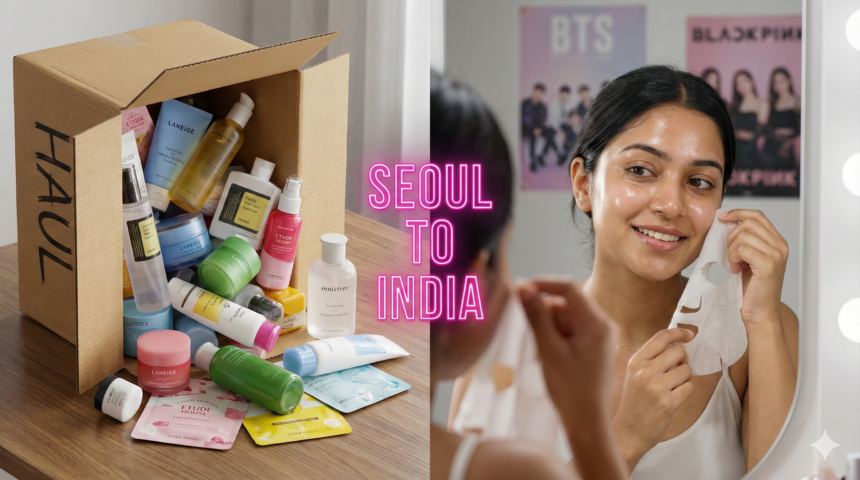
Open YouTube, search “Nykaa Pink Friday Sale Haul,” and you will see creators buying 10 items at once. This is “Haul Culture.”
Platforms like Maccaron, Tira, and Limese have made K-Beauty accessible. You no longer need a cousin flying back from the US to bring you these products.
- The “Mini” Strategy: Brands sell 20ml “mini” versions. It’s a trap. You buy a mini for ₹500, fall in love, and end up buying the ₹2000 bottle next month.
- The Packaging: Let’s be real. The packaging is cute. Using a pink serum just feels better than using a medical tube.
2026 Trends: From 10-Step to “Skinimalism”
In 2018, the trend was the famous “10-Step Korean Routine.”
- Oil Cleanser
- Water Cleanser
- Exfoliator
- Toner
- Essence
- Serum
- Sheet Mask
- Eye Cream
- Moisturizer
- Sunscreen
The Shift in 2026:

Nobody has time for that anymore. Indian Gen Z has moved to “Skinimalism” (Skin + Minimalism). They are picking the best 3-4 steps.
- The New Routine: Double Cleanse -> Snail Mucin -> Sunscreen. Done.
Also, watch out for PDRN (Salmon DNA). It is the buzzing new ingredient in 2026, promising to repair skin at a cellular level. Yes, we went from Snails to Salmon.
Top Brands Ruling the Indian Market
If you are new to this cult, here are the titans you need to know.
| Brand | Cult Product | Price Point |
| COSRX | Snail 96 Essence | Mid-Range (₹1450) |
| Laneige | Lip Sleeping Mask | Premium (₹1600) |
| Beauty of Joseon | Rice + Probiotics Sunscreen | Mid-Range (₹1500) |
| Innisfree | Green Tea Seed Serum | Accessible (₹800+) |
| Klairs | Supple Preparation Toner | Sensitive Skin Friendly (₹1400) |
Conclusion: A Lifestyle, Not Just a Lotion
The Indian Gen Z obsession with K-Beauty isn’t just about vanity. It is a form of self-care in a hyper-stressful world.
In a country where we are constantly told to “hustle,” the K-Beauty routine forces you to slow down. You can’t rush a sheet mask. You have to sit still for 15 minutes.+1
So, is it worth the hype?
Well, if it makes you look like a glazed donut and feel like the main character in a K-Drama, then yes. Take my money.
Frequently Asked Questions (FAQ)
Q1: Is K-Beauty suitable for Indian skin?
Ans: Absolutely. Korean products focus on hydration and barrier repair, which helps Indian skin deal with harsh sun, pollution, and dehydration. However, always patch-test new products.
Q2: What is the correct order to apply these products?

Ans: The general rule is Thinnest to Thickest.
Cleanser -> Toner -> Essence/Serum -> Moisturizer -> Sunscreen.
Q3: Is Snail Mucin animal cruelty?
Ans: Most reputable brands like COSRX extract mucin without harming the snails. The snails are placed on a mesh in a dark room (which they like) and the mucin they leave behind is collected. No snails are crushed!
Q4: Where can I buy authentic K-Beauty in India?
Ans: Stick to authorized platforms like Nykaa, Maccaron, Tira, and Limese. Avoid random Instagram sellers as fake products are common.
🔗 Social Proof
See what the community is talking about. Check out the latest discussions on the “Indian Skincare Addicts” trend: