


Let’s breathe a collective sigh of relief. The Interim Budget of February 2026 didn’t drop a bomb on us. In fact, Finance Minister Nirmala Sitharaman’s announcement was arguably the best kind of news for the middle class: Stability.
For years, we have glued our eyes to the TV screen every February 1st, praying that the government doesn’t invent a “breathing tax.” This year, the headline isn’t about change; it’s about continuity. The massive overhauls from the previous fiscal year (FY 2025-26) have been retained, cementing the New Tax Regime as the king of the jungle.
If you are earning ₹12 Lakh a year and paying zero tax, you might think your calculator is broken. It isn’t. The “New Normal” of taxation is here, and it is surprisingly generous. Let’s decode the math, the logic, and why your Chartered Accountant might be a little less stressed this year.
The “New” Tax Calculator: How It Actually Works
When we say “New Tax Calculator,” we are referring to the solidified slabs under the default New Tax Regime for the Financial Year 2026-27.
The government’s strategy is clear: Kill the paperwork. They want you to stop hoarding fake rent receipts and just pay a lower rate on a flat income.
The Magic Slabs (FY 2026-27)
Here is the breakdown of the current tax structure that remains effective post-Budget 2026.
- 0 to ₹4 Lakh: NIL (Go buy a pizza)
- ₹4 Lakh to ₹8 Lakh: 5%
- ₹8 Lakh to ₹12 Lakh: 10%
- ₹12 Lakh to ₹16 Lakh: 15%
- ₹16 Lakh to ₹20 Lakh: 20%
- ₹20 Lakh to ₹24 Lakh: 25%
- Above ₹24 Lakh: 30%
Wait, did you spot the hidden gem? The Section 87A Rebate.
If your taxable income is up to ₹12 Lakh, the government gives you a full tax rebate. You calculate the tax, and the government waives it off.
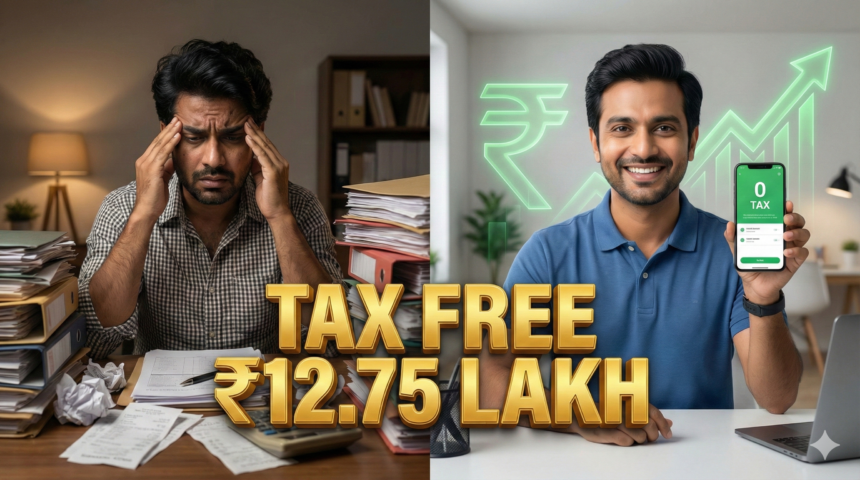
The Golden Number: ₹12.75 Lakh
If you remember nothing else from this article, remember this number: ₹12,75,000.
For salaried employees, this is the new “Zero Tax” threshold. How?

- Gross Salary: ₹12,75,000
- Less Standard Deduction: ₹75,000 (Flat deduction for all salaried folks)
- Net Taxable Income: ₹12,00,000
- Tax Payable: Zero (Thanks to Section 87A Rebate)
This is a massive leap from the days when earning ₹5 Lakh felt like a crime. The middle class, effectively, has more disposable income in 2026 than it did five years ago, assuming you aren’t spending it all on overpriced coffee.
Old Regime vs. New Regime: The Battle Continues
Is the Old Regime dead? Not yet, but it’s on a ventilator. The Old Regime is now “optional,” meaning you have to manually select it if you want to use it. If you do nothing, you are automatically moved to the New Regime.
Here is a quick comparison to help you decide if you should still cling to your 80C investments.
| Feature | New Tax Regime (Default) | Old Tax Regime (Optional) |
| Standard Deduction | ₹75,000 | ₹50,000 |
| Section 80C (PPF/LIC) | Not Available | Available (Up to ₹1.5 Lakh) |
| HRA / LTA Exemptions | Not Available | Available |
| Tax-Free Income Limit | ₹12 Lakh (via Rebate) | ₹5 Lakh (via Rebate) |
| Highest Tax Rate | 30% (Above ₹24 Lakh) | 30% (Above ₹10 Lakh) |
| Complexity | Low (No proofs needed) | High (Need investment proofs) |
The Verdict: Unless you have massive HRA claims (like paying ₹50k/month rent in Mumbai) AND heavy home loan interest, the New Regime is mathematically better for 90% of middle-class taxpayers.
Impact on the Middle Class: The “Consumption” Boost
Why is the government doing this? It’s basic economics mixed with a bit of psychology.
1. More Cash in Hand
By raising the tax-free limit to ₹12.75 Lakh, the average software engineer, teacher, or bank PO has an extra ₹20,000 to ₹40,000 in their pocket annually compared to the old slabs.
2. The Death of “Forced” Savings
In the past, we bought useless insurance policies just to save tax under 80C. Now, you can invest that money where it actually grows—like in Mutual Funds or Stocks—without worrying about tax-saving lock-ins.
3. Senior Citizen Relief
Budget 2026 maintained the higher interest deduction limit. Senior citizens can now earn up to ₹1 Lakh in bank interest without paying a single rupee of tax on it (under Section 80TTB).
Fact Check: The surcharge for the super-rich (income > ₹5 Crore) was reduced from 37% to 25% in the previous budget, and this remains unchanged. So, even the wealthy are celebrating.
Is It All Sunshine and Rainbows?
Not entirely. The “Standard Deduction” staying at ₹75,000 was a slight disappointment. Many experts on X (formerly Twitter) predicted it would touch ₹1 Lakh this year to combat inflation.
Furthermore, if you are a freelancer, you don’t get that ₹75,000 deduction. You still have to rely on Section 44ADA (presumptive taxation) to save your skin.
Conclusion: Keep It Simple, Silly
Budget 2026 didn’t reinvent the wheel; it just greased the axles. The message to the Indian middle class is clear: Stop obsessing over tax hacks.
The New Tax Calculator is designed to be boringly simple. You earn, you subtract ₹75,000, and you check the slab. For the vast majority of us earning under ₹12 Lakh, the taxman is no longer a villain—he’s just a bystander.
So, go ahead and plan that vacation with your tax savings. Just don’t forget to file your ITR by July 31st!
Frequently Asked Questions (FAQ)
Q1: What is the tax for a salary of ₹12 Lakh in 2026?
Ans: ZERO. Under the New Tax Regime, taxable income up to ₹12 Lakh is fully exempt due to the rebate u/s 87A.
Q2: Has the 80C limit increased in Budget 2026?
Ans: No. The Section 80C limit remains stuck at ₹1.5 Lakh, and it is only available in the Old Tax Regime. The government wants you to shift to the New Regime, which has no 80C benefit.
Q3: Can I switch between Old and New Regimes?
Ans: Yes! Salaried individuals can switch regimes every year based on what benefits them. However, business owners can only switch once in their lifetime.

Q4: What is the Standard Deduction for FY 2026-27?
Ans: It stands at ₹75,000 for salaried employees and pensioners under the New Tax Regime.
Q5: Is HRA exemption removed?
Ans: HRA exemption is removed only if you opt for the New Tax Regime. If you stick to the Old Regime, you can still claim HRA.
🔗 Social Proof
See what financial experts are saying about the stability of the new slabs: